
Verified Martinez City Directory Sets
Verified Martinez directory evidence sits in several places. County history collections, a library catalog, FamilySearch, and local museum material each hold a piece. Some items are true residential directories. Others are property, court, newspaper, or vital indexes. These bridge the years between printed volumes. The table separates collection type, years, holding place, and access route. That separation keeps a research lead honest. It also stops a search from inventing a continuous run that never existed.
| Collection | Verified years or span | Where held | Access |
|---|---|---|---|
| McKenney Pacific Coast Directory | 1883-84 | FamilySearch catalog 2610080 | Catalog and source inquiry |
| Gazette vital abstracts | 1864-1899, three indexed volumes | FamilySearch catalog 2018143 | Digitized finding aid |
| Polk Richmond and Contra Costa County Directory | 1914-15 | FamilySearch evidence; local shelf confirmation needed | Verify volume access before travel |
| Richmond and Martinez telephone directories | 1920s-1930s confirmed as used by a CCCHS researcher | History Center | In person; exact volumes need inquiry |
| CCCHS tax assessor books | Yearly 1850-1910 | History Center, 724 Escobar | PACT, staff, or physical research |
| Martinez Museum assessment books | 1884 through late 1940s | Borland House, 1005 Escobar | In person on museum days |
| Federal census schedules | 1860-1950 local schedules | NARA, FamilySearch, Ancestry Library | Library or subscription access |
No authoritative source confirms a complete annual Martinez residential or reverse-directory run, a literal sample page, or exact Sanborn years. A careful catalog search records that uncertainty beside each year. Never fill the blank with a generic publisher pattern.
Martinez Polk 1914-15 Starting Point
The Polk Richmond and Contra Costa County Directory for 1914-15 is the clearest verified residential lead. It serves a Martinez city directory search. FamilySearch supplies the source evidence. Local shelf confirmation is still needed. Before treating a name as a household entry, note the exact title page, the geographic scope, and the publication year. Also note whether the volume has an alphabetical section, a street section, or both.
The FamilySearch Gazette catalog is a separate collection of indexed newspaper vital abstracts from 1864-1899. It can locate births, marriages, and deaths around a directory year. Treat it as a finding aid. It does not prove that every event has a surviving certificate. The Gazette bridges a printed local source to a searchable catalog. That bridge works both ways.
A Gazette abstract can supply a date or a name variant. That detail makes a later directory entry easier to test against the county custodian.
Three Martinez Desks Hold Different Pieces
The Martinez Library sits at 740 Court Street. It holds a small historical collection. It also offers general database access. Hours run Tuesday noon to 8, Wednesday and Thursday 10 to 6, and Friday and Saturday 9 to 5. The county system's stronger genealogy collection sits at Walnut Creek. Ancestry Library Edition works in-library without a card requirement. Verify database access and hours before any trip.
The Contra Costa County Historical Society History Center sits at 724 Escobar. It is the deeper local stop. It keeps county records since 1850. Its holdings include tax books, court and probate material, directories, obituary and biography clippings, town files, yearbooks, and maps. PACT terminal access is free. The Martinez Museum at Borland House adds Martinez-specific assessment books, photographs, maps, clippings, and census material. Each desk answers a different historical question.
Record groups here include court, probate, deeds, homesteads, naturalizations, vital records, Great Registers, and fiscal material. The California State Archives county and city record guide offers another route. Its listed Contra Costa holding covers fiscal records from 1873-1908. The State Archives collection guide also helps place Martinez collection research in the wider county record system.
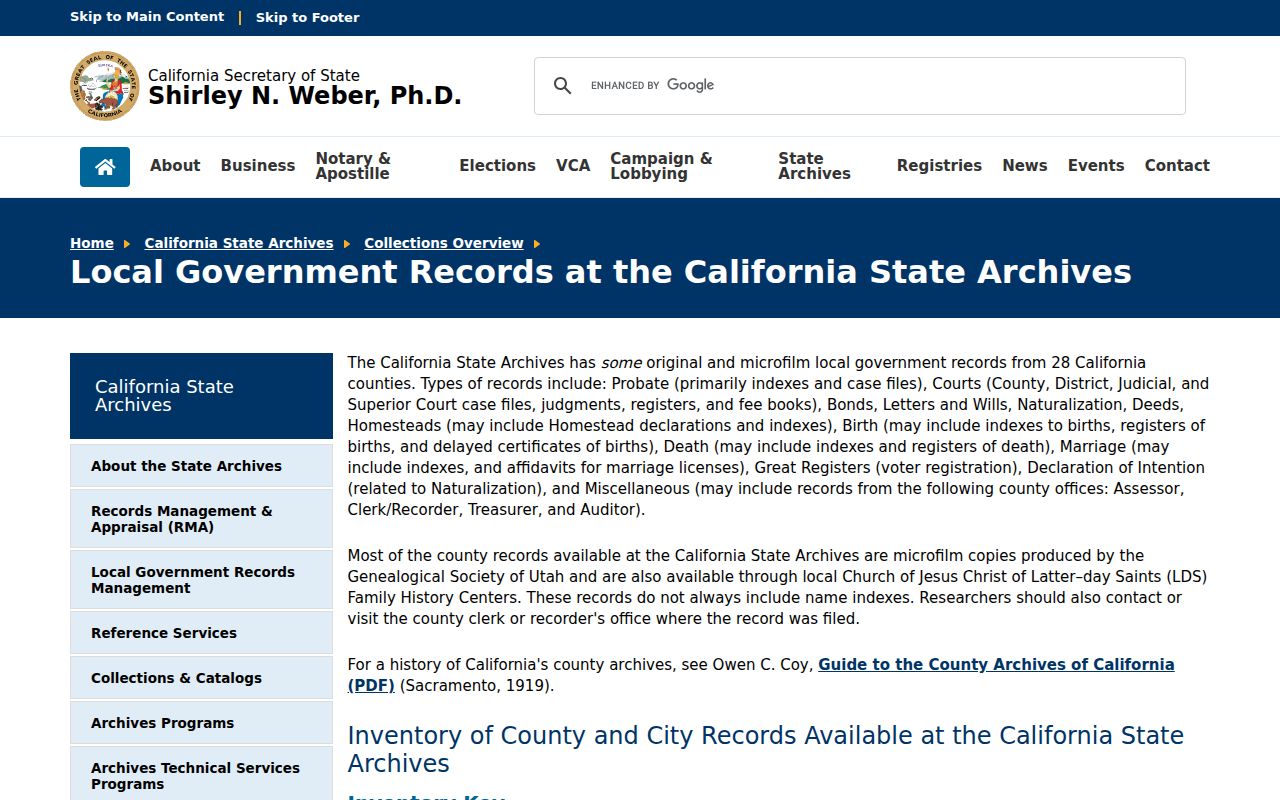
Archives, library databases, and local shelves each play a role. For current legal records, the Clerk-Recorder, Assessor, and Superior Court remain the authoritative custodians.
| 1849 | Martinez founded; early local place and property records begin in a changing town. |
|---|---|
| 1851 | Martinez becomes the Contra Costa County seat, concentrating county record access. |
| 1876-1881 | Incorporation, rail, and telephone milestones change the town’s administrative and directory context. |
| 1986 | RecorderWorks modern name-index coverage begins for recorded documents. |
| 1997 | Recorder APN deed searching begins its documented narrower range on March 3. |
Inspect a Martinez Directory Entry
The county publishes no authoritative digitized Martinez residential page, so a literal local entry and its abbreviation key remain unverified. Open the exact volume yourself. Photograph or note its key. Record only what the page prints. A local volume may use an initial, a spouse or widow notation, an occupation, a business connection, a residence, or a street-order cross-reference, but the presence of a field must be demonstrated in that volume.
| Name form | Copy initials, spelling, accents, and aliases exactly as printed. |
|---|---|
| Spouse or widow mark | Record it only if the local entry uses it; it can be a family clue. |
| Occupation or business | Note the printed trade or employer when present, without treating it as a home address. |
| Residence | Capture the house number and street as printed and note an occupancy mark if shown. |
| Owner or occupancy symbol | Do not assume one exists; inspect the volume’s explanation. |
- Criss-cross directory
- A street-order or address-first section used to move from a place to a dated name entry.
- Householder index
- A name or household list that points to a residence; its scope depends on the volume.
- Abbreviation key
- The volume’s own legend for shortened occupations, relationships, or address marks.
Note: A directory’s omission may reflect publication lag, non-subscription, spelling, a move, or limited occupancy coverage rather than death.
Track Martinez Spelling, Spouses and Occupations
Martinez names change shape across a city directory run. Italian and Portuguese family names, diacritics, initials, birth surnames, and anglicized spellings all appear. Test a surname with and without an accent. Try a first initial, a spouse or co-owner, a business name, and an adjacent street clue. The entry grows stronger with each echo. The same address, occupation, or family relationship may recur in a later year.
Never force a match just because a name appears in the same town. Compare the publication date and the address. Weigh the household relationship, the business connection, and a second record such as a newspaper, deed, probate file, or census. When modern confirmation is needed, the Martinez resident lookup route can test the historical clue against current official records. It does this without pretending the directory itself is current.
Pair Martinez Directories with Census Years
A city directory is often annual or near-annual. A census is a decennial snapshot. Pair the dated directory with the nearest census. Then mark the gap between the enumeration date and the publication date. Census schedules currently reach 1950 under the 72-year release rule. They can show a household and dwelling at an enumeration date. But they do not prove continuous occupancy between decades.
| Period | Pairing question | What the comparison can reveal |
|---|---|---|
| 1914-15 directory | Does the name and address fit the next available census evidence? | Household spelling, address, and possible family group |
| 1920s telephone books | Does the telephone entry match a directory or newspaper name? | Contact listing and business or household continuity |
| 1930 and 1940 census | Did the household remain at the same dwelling on enumeration day? | Decennial household snapshot and relationship clues |
| 1950 census | Does the late historical entry fit the address and family trail? | Latest currently released local census checkpoint |
- Copy the entry and publication date from the volume.
- Check the nearest census year and its enumeration date.
- Use the street or address section to test a move, spelling variant, or neighbor.
- Fill the interval with assessment books, newspapers, deeds, probate, or permits.
Martinez Newspaper Runs Fill Directory Gaps
A Martinez residents directory is not the only paper trail in town. Newspapers rescue researchers whenever a city directory skips a year or a family name shifts spelling. The Contra Costa County Library holds Daily Press runs from 1900 through 1905. The Martinez Daily Standard spans 1917 to 1930, with earlier issues online and on film. Martinez Herald and Morning Herald run from 1931 to 1940. The Morning News-Gazette covers November 1963 through April 14, 1977, and its successor, the Martinez News-Gazette, runs from April 1977 to December 2019. The Martinez Record appears from 1996 to 2002, then simply Record from April 2002 onward.
Search every successor and predecessor title, not just the paper a family remembers. Obits, marriage notices, building news, probate filings, business announcements, and legal notices can tie a person to an address or a relative. Remember that a newspaper is a dated report, never a complete street directory. Weigh it against tax books, the census, and whatever the record custodian holds.
Start with the library's historical newspaper holdings page for checking titles and dates.
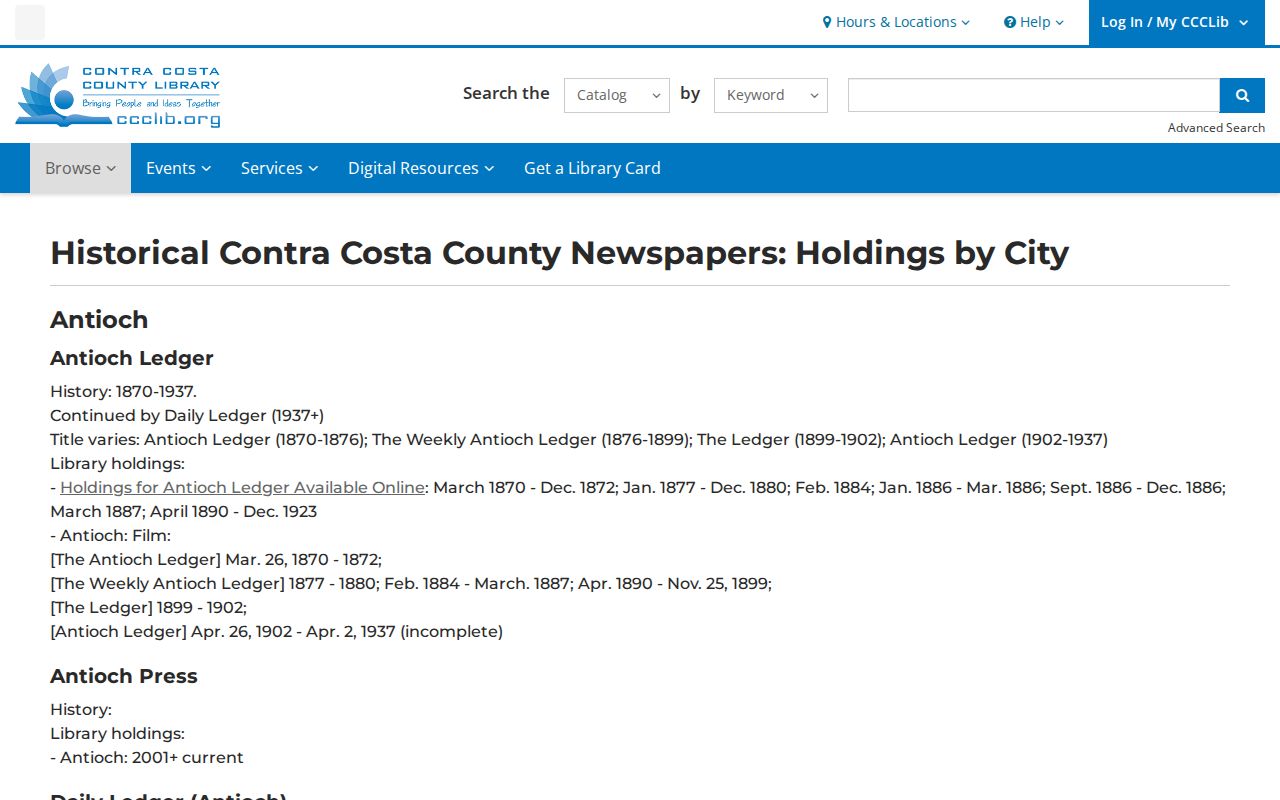
Coverage varies by title, with some newspapers online, others on film, and some only in the library. Note the access mode beside each date so an online miss is not mistaken for an article that never existed.
Martinez PACT Adds Local Names
The History Center's PACT terminal is the insider route for Martinez city directory research. Its court, tax, map, clipping, and directory material is not unified in any public web search. So past residents of Martinez surface here in ways they never would elsewhere. The collection holds more than 9,300 indexed court files naming over 61,000 people. Yearly assessor books and physical indexes run through 1911. Those figures describe the collection's reach, not a roster of current residents.
Plan a visit around the Tuesday through Thursday hours. You can also use the first and third Saturday schedule. Members self-research at no charge, while nonmembers pay the stated hourly rate. Staff research carries its own member and nonmember rates. Request a specific person, address, record class, and date range rather than an open-ended sweep.
The History Center research service page covers PACT, hours, and the staff route.
A local desk like that can surface the clue that guides a later name search. It points toward the spelling, address, or record type worth testing next.
A Martinez Directory Entry Is Dated
A historical directory answers one question. It shows who was listed at a place or in a business during one publication period. It proves no current resident, no continuous presence, no legal title. A missing entry may signal a move or an unlisted household. It may also reflect a publication gap, a street renumbering, a non-subscription, or a simple name variant.
For a family-history conclusion, record the exact title, year, page, section, spelling, and access source. Then compare the entry against assessment books, census records, newspapers, deeds, probate, or an obituary. The strongest Martinez directory trail is transparent. It shows what was read, what was inferred, and what still needs a custodian or collection inquiry.